
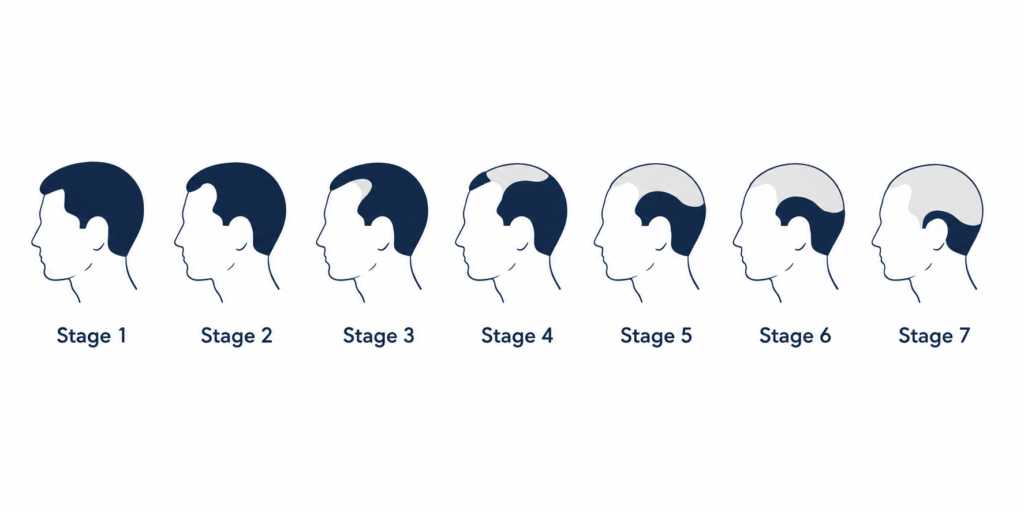
You’ve probably already Googled a few versions of this same question — typed “hair loss stages” into your phone at 11pm, scrolled past a chart, and closed the tab without really knowing where you land on it. That’s normal. Dermatology uses a specific classification system, called the Norwood scale (or Hamilton-Norwood scale), to describe how male pattern hair loss typically progresses — and knowing your rough stage isn’t about labeling yourself, it’s about understanding what’s actually happening and what your options look like from here. Here’s what each of the seven stages actually means, described the way you’d actually see it in a mirror.

1. Norwood Stage 1: No Noticeable Recession
Stage 1 is essentially the baseline — a hairline with no visible recession, sitting where it did in your late teens. This isn’t really a “stage of hair loss” in the practical sense; it’s the reference point every other stage is measured against. The American Academy of Dermatology identifies heredity as the leading cause of the progression these stages describe, which is why some men pass through stage 1 for decades while others begin shifting out of it much sooner.
2. Norwood Stage 2: A Slightly Higher Hairline
Stage 2 introduces mild recession at the temples, creating slight indentations on either side of the hairline while the front-center remains largely unchanged. This is also roughly where a naturally “maturing” hairline overlaps with early genetic thinning, which is why stage 2 is the hardest stage to interpret with confidence — a slight temple recession alone doesn’t confirm ongoing pattern loss. The clearest way to tell the two apart is time: a maturing hairline settles into place and stops, while genetically driven recession tends to keep moving, even slowly, year after year.
3. Norwood Stage 3: The First Clinically Significant Stage
Stage 3 is where the Hamilton-Norwood classification, as summarized in dermatology literature, identifies the first pattern considered clinically significant hair loss — deeper, more defined recession at the temples, often forming a distinct M, V, or U shape. A related variant, sometimes labeled stage 3 vertex, adds early thinning at the crown alongside temple recession rather than instead of it.
4. Norwood Stage 4: Crown Involvement Begins
By stage 4, hairline recession is more pronounced, and a separate area of thinning becomes visible at the crown (vertex). Critically, at this stage the hairline and the crown thinning are usually still separated by a noticeable band of denser hair running across the top of the head — the two areas haven’t merged into one continuous zone yet. This is often the stage where men first start actively researching options, since the change is now visible to other people, not just to the man himself in the mirror.
5. Norwood Stage 5: The Band Narrows
Stage 5 looks similar to stage 4 at a glance, but the strip of hair separating the receded hairline from the thinning crown becomes narrower and sparser. Both regions are larger than in stage 4, and the remaining band connecting them is visibly thinning too, signaling that the two areas are on a path to merge.
6. Norwood Stage 6: The Regions Merge
At stage 6, the separating band of hair is gone. The front and crown regions of hair loss connect into one continuous area, leaving hair only around the sides and back of the head. This is a substantial change from stage 5, though the sides and back typically remain thick and stable at this point, since that hair is generally less sensitive to the hormonal process driving the pattern.
7. Norwood Stage 7: The Most Advanced Stage
Stage 7 is the most extensive pattern on the scale — only a band of hair remains around the sides and lower back of the head, and it’s usually narrower and less dense than in earlier stages. Not every man who experiences pattern hair loss reaches stage 7; progression speed and final extent vary enormously from person to person, and many men remain at an earlier stage indefinitely.
A Quick Way to Estimate Your Own Stage
Without a clinician in front of you, the most reliable self-check is comparing two things separately: how far your hairline has receded at the temples, and whether there’s a distinct, separate thinning patch at the crown. If it’s hairline only, you’re likely somewhere in stages 2–3. If there’s a crown patch but the two areas are still clearly separated by a band of hair, that’s the stages 4–5 range. Once that separating band disappears, you’re looking at stage 6 or beyond. This isn’t a diagnosis — it’s a starting point for a more informed conversation if you decide to have one.
Wherever you land on this scale, earlier stages give you more room to act. The same DHT-follicle mechanism drives progression at every stage on this chart, which is exactly why options for slowing it tend to be broadest in stages 2 through 4, before a stage 5 or 6 pattern sets in.
Why Progression Speed Varies So Much
Genetics doesn’t just determine whether pattern hair loss happens — it also influences how fast it moves. Mayo Clinic notes that the pace and pattern of hereditary hair loss vary significantly from person to person, which is consistent with what you’d expect from a chart like this one: some men reach stage 4 within a few years of their first signs, while others stay at stage 2 or 3 for decades. Because of that variability, “which stage am I in” is less useful as a fixed label and more useful as a snapshot — worth rechecking every year or two rather than assumed to be static, especially if you’re paying attention to the early signs of a receding hairline that tend to show up before a stage is obvious on a chart like this one.
It also helps to compare yourself to yourself, not to the chart in isolation. A phone photo taken from the same angle every six months, in similar lighting, tends to be far more useful for tracking your own progression than trying to match your reflection to a static illustration. If two consecutive photos look essentially the same, that’s genuinely useful information — it may mean you’re at a stable point rather than mid-progression, which changes how urgently you need to act.
If you’ve identified yourself somewhere in the stage 2–4 range, that’s typically the window where options are broadest, since the goal at that point is usually slowing further progression rather than trying to reverse an advanced pattern. Dutasteride, a prescription DHT blocker sometimes used off-label for hair loss, works on that same DHT-follicle process at every stage on this scale, and for many men earlier in the progression it’s associated with slower shedding and thicker-looking hair over several months of consistent use. It isn’t right for every situation, and a professional evaluation is the right next step to confirm whether your stage and pattern are a fit. See how dutasteride works to slow DHT-driven progression.
Medical disclaimer: This article is for informational purposes only and is not a substitute for professional medical advice. A dermatologist or clinician can give you a more accurate assessment of your stage and options than any chart alone.
This article contains an affiliate link; we may earn a commission if you make a purchase, at no additional cost to you.
Frequently Asked Questions
What is the Norwood scale used for?
The Norwood scale (also called the Hamilton-Norwood scale) is the classification system dermatologists and researchers use to describe the typical progression of male pattern hair loss, from stage 1 (no recession) through stage 7 (the most advanced pattern).
How fast do you progress through the Norwood stages?
There’s no fixed timeline. Some men move through several stages within a few years, while others remain at an early stage for decades or never progress much further. Genetics is the main factor behind both whether it happens and how fast.
Can you skip stages or go backward on the Norwood scale?
You generally don’t skip stages — progression follows the pattern in order, even if the pace varies. Moving backward on your own isn’t typical, though some treatments can improve density within a stage without necessarily reversing the classification itself.
What’s the difference between Norwood stage 3 and stage 3 vertex?
Standard stage 3 involves temple recession alone. Stage 3 vertex describes a variant where early crown thinning appears alongside temple recession rather than the crown staying unaffected, which some clinicians consider an earlier or more aggressive presentation.
Does everyone with pattern hair loss eventually reach stage 7?
No. Many men remain at an earlier stage indefinitely. Final extent and progression speed vary significantly from person to person, and reaching stage 7 is not an inevitable outcome of having pattern hair loss.
At what stage should you talk to a doctor about hair loss?
There’s no wrong stage to ask questions, but many clinicians note that options for slowing progression tend to be broadest earlier in the process, roughly stages 2 through 4, before a pattern becomes more extensive.
Is the Norwood scale accurate for every man?
It’s a useful general framework, but real-world patterns don’t always match the chart exactly — some men show asymmetric recession or a combination of features between stages. It’s a helpful reference point, not a precise diagnostic tool.