
A receding hairline rarely announces itself. It shows up in inches, not overnight — a few millimeters at the temples this year, a slightly wider part next year, until one day the change is obvious in a mirror you’ve looked in a thousand times. The signs of a receding hairline are usually visible months or years before most guys consciously register them, because the brain is remarkably good at normalizing gradual change. Below are ten of the earliest, most reliable signs of a receding hairline — the kind that are easy to miss in the moment but obvious once you know what to look for.

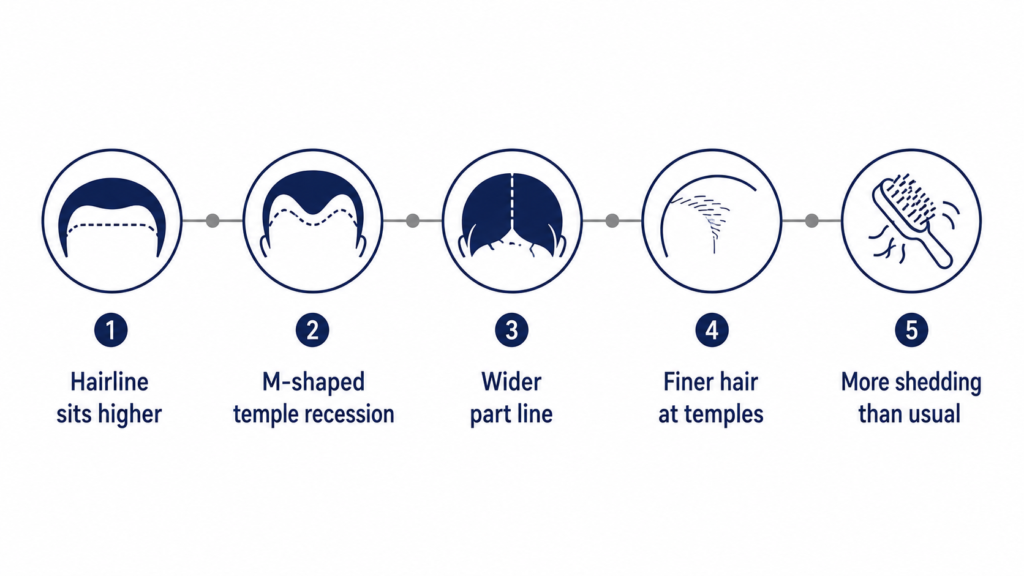
1. Your Hairline Sits Higher Than It Used To
The single most direct sign is distance: your forehead measures noticeably taller than it did a few years ago. Hold a straight edge or your fingers horizontally above your eyebrows the way you would in an old yearbook photo, and compare. A shift of half an inch or more from where your hairline sat in your late teens is one of the clearest early signs of a receding hairline, especially if the distance keeps growing rather than settling.
2. You’re Developing an M-Shaped Hairline
Instead of a straight or gently curved line, the hair above each temple starts pulling back faster than the hair at the center, leaving a peak or “widow’s peak” look in the middle. This M-shape is one of the most recognizable receding-hairline patterns, and it tends to deepen gradually rather than appear all at once.
3. Your Part Line Looks Wider in Photos
Photos are more honest than mirrors because you’re not unconsciously angling your head to a flattering position. If your usual part looks noticeably wider in recent pictures — more scalp visible along the line — that’s a sign worth paying attention to, particularly if it’s a change from photos taken a year or two earlier.
4. The Hair at Your Temples Feels Finer
Before hair disappears at the temples, it often changes texture first. Individual strands become thinner, softer, and less pigmented — a process called miniaturization. Run your fingers along your temples and compare the texture to hair at the crown; a noticeable difference in thickness is frequently an earlier signal than visible thinning itself.
5. You’re Finding More Hair Than Usual
Everyone sheds hair daily, and the American Academy of Dermatology notes that losing 50 to 100 hairs a day is normal. What’s worth noticing is a sustained increase beyond that — more strands on your pillow, in the shower drain, or on your hands after running them through your hair, especially concentrated around the front and temples rather than spread evenly across your scalp.
6. Your Forehead Looks Like It’s Expanding
This is really sign #1 viewed from a different angle, but it’s worth calling out separately because people notice it differently — less as “my hairline moved” and more as “my forehead looks bigger.” If friends or a barber have commented on it, or you’ve started angling selfies differently, that’s usually your own eye catching the same shift.
7. One Side of Your Hairline Looks Different From the Other
Recession isn’t always symmetrical. It’s common for one temple to recede noticeably faster than the other for a while, creating a lopsided look before both sides eventually even out. An uneven hairline is easy to dismiss as “just how my hair grows,” but it’s frequently an early, asymmetric stage of the same process.
8. Styling Your Hair the Old Way Doesn’t Work Anymore
A hairstyle that used to cover your temples or hairline effortlessly now needs more product, a different part, or extra time to get the same coverage. When your go-to haircut stops working the way it used to, it’s often because there’s simply less hair there to work with than there used to be.
9. Old Photos Tell a Story You Haven’t Wanted to See
Pull up photos from three, five, and ten years ago side by side. This kind of direct, same-lighting comparison is one of the most reliable ways to catch a receding hairline in progress, because it removes the day-to-day normalization that makes gradual change so easy to miss in a mirror.
10. You Recognize the Pattern From a Parent or Grandparent
Male pattern hair loss is strongly hereditary, and research summarized by the National Institutes of Health estimates roughly half of men show some degree of pattern hair loss by age 50. If you’re starting to see your father’s or grandfather’s hairline reflected in your own, that family resemblance is itself a meaningful, if informal, sign worth taking seriously.
What to Do If You Recognize These Signs
None of these signs on their own is proof of anything — hairlines naturally shift a little through your late teens and twenties as a “mature” hairline settles into place, and that’s different from ongoing recession. What matters is the pattern: is the change continuing, or did it stabilize years ago? If you’re noticing two or three of these signs together and the change feels ongoing rather than settled, that’s simply useful information about where you are — and understanding your own hairline earlier gives you more options and less guesswork later, whatever you decide to do about it.
If you’re thinking about treatment, one thing most people don’t account for upfront: hair-loss treatments take significantly longer to show results than most people expect. Understanding that timeline before you start is one of the main reasons people stick with treatment long enough to actually see it work — and one of the main reasons others quit two months in believing it failed.
Once you’ve placed yourself on this list, it’s worth knowing what a genetically driven pattern like this can actually respond to: dutasteride, a prescription DHT blocker sometimes used off-label for hair loss, is associated with slower shedding and thicker-looking hair over several months of consistent use for men whose thinning is genetically driven. It isn’t right for everyone, and a clinician is the best person to confirm whether your pattern is a fit before you start anything. See how dutasteride targets the DHT process behind pattern hair loss.
Medical disclaimer: This article is for informational purposes only and is not a substitute for professional medical advice. Always consult a qualified healthcare provider before starting any hair-loss treatment.
This article contains an affiliate link; we may earn a commission if you make a purchase, at no additional cost to you.
Frequently Asked Questions
What’s the difference between a mature hairline and a receding hairline?
A mature hairline shifts back slightly (often around half an inch) during your late teens to mid-twenties and then stabilizes. A receding hairline keeps moving — the change continues year over year rather than settling into a stable line.
At what age does a hairline typically start receding?
It varies widely, but signs can appear as early as your late teens or twenties for some men, while others don’t notice changes until their thirties or forties. Genetics plays a large role in timing.
How much daily hair shedding is considered normal?
According to the American Academy of Dermatology, losing 50 to 100 hairs a day is normal. Shedding well beyond that range, especially if sustained for weeks, is worth paying attention to.
Can a receding hairline stop on its own?
A mature hairline stabilizes on its own after its initial shift. A genuinely receding hairline tends to continue gradually over time rather than reversing without intervention, though the pace varies a lot from person to person.
Is a receding hairline always genetic?
Genetics is the most common factor behind a receding hairline in men, but hormonal changes, certain medications, stress, and other health factors can also contribute or accelerate the pattern.
Does a receding hairline mean you’re going bald?
Not necessarily, and not on any fixed timeline. A receding hairline is one early pattern within male pattern hair loss, but how far it progresses — and how fast — differs significantly from person to person.
How can I tell if my hairline is receding without comparing old photos?
Look at texture and density at the temples versus the crown, check whether your part looks wider than it used to, and pay attention to whether your usual hairstyle still covers the same area it always has.