
Somewhere along the way, you probably picked up a “rule” about hair loss — from a barber, a relative, a forum thread at 1am — and filed it away as fact without ever checking it. Maybe it was about hats. Maybe it was about your mom’s side of the family. Most of these ideas sound plausible enough that nobody questions them, which is exactly why they’ve survived for decades. Here are eight of the most common hair-loss myths, and what actually holds up when you look at the evidence.

1. Myth: Wearing Hats Causes Hair Loss
This one persists mostly because it feels intuitively true — cover your scalp, restrict its “airflow,” and something bad happens. But hair follicles get their nutrients from your bloodstream, not from air exposure, and normal hat-wearing doesn’t restrict blood flow enough to affect hair growth. Unless a hat is so tight it’s constantly pulling on the hairline (which circles back to traction, a real but separate issue), hats themselves aren’t the cause. If hat-wearing genuinely correlated with hair loss, construction workers, athletes, and military personnel would show dramatically higher rates than anyone else — and they don’t.
2. Myth: Frequent Shampooing Causes Hair Loss
The American Academy of Dermatology notes that losing 50 to 100 hairs a day is a normal part of the hair cycle, and shampooing simply washes away hairs that were already in their shedding phase — it doesn’t cause new hair loss. Washing less often just means those same hairs accumulate and shed all at once later, which can actually make hair loss look worse, not better.
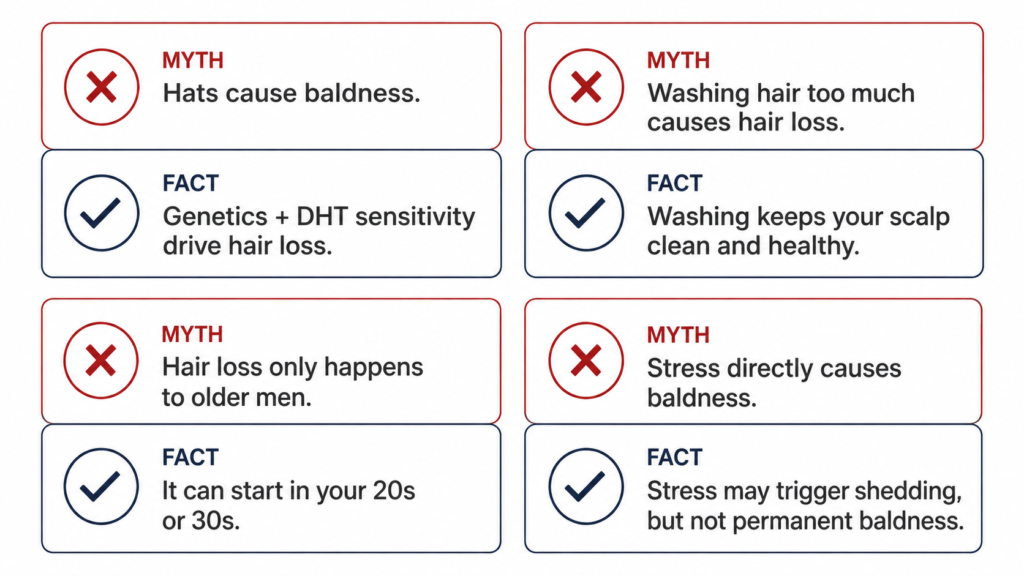
3. Myth: Stress Always Causes Permanent Hair Loss
Stress can absolutely trigger hair shedding — a condition called telogen effluvium — but Mayo Clinic describes this stress-related shedding as typically temporary, usually resolving within months once the underlying stressor eases. Ordinary day-to-day stress isn’t strong enough to trigger this response on its own; it usually takes a genuinely major physical or emotional event. The confusion often comes from timing: the shedding shows up two to three months after the stressful event, not immediately, which makes it easy to blame the wrong week entirely.
4. Myth: Shaving Your Head Makes Hair Grow Back Thicker
This myth is an optical illusion. Shaved hair grows back with a blunt tip instead of a naturally tapered one, which can make regrowth feel coarser or look darker for a short period. But the hair shaft’s actual diameter and growth rate are determined at the follicle, well below the skin, and cutting or shaving has no effect on either.
5. Myth: Baldness Only Comes From Your Mother’s Side
This one has a kernel of truth buried in it, which is part of why it spreads so easily. One of the genes linked to pattern hair loss sits on the X chromosome, which you only get from your mother — but the genetics of androgenetic alopecia are understood to be polygenic, meaning multiple genes from both parents contribute. A father with a full head of hair doesn’t rule out a strong genetic risk from elsewhere in the family. In practice, this means looking only at your dad and skipping grandparents, uncles, and your mother’s brothers gives you an incomplete picture of your actual risk.
Tired of guessing which myths apply to your situation? The clearest way out of guessing is ruling causes in or out with an actual evaluation, rather than another forum thread or half-remembered rule.
6. Myth: High Testosterone Causes Baldness
It’s not testosterone levels that matter — it’s how sensitive your hair follicles are to DHT, a byproduct of testosterone, at the genetic level. Two men can have identical testosterone levels and experience completely different amounts of hair loss, because the follicle sensitivity, not the hormone level itself, is what genetics actually controls.
7. Myth: You Can Tell Exactly How Much Hair You’re Losing Just From Shedding
Watching hairs collect in the shower drain feels like data, but it’s an unreliable way to gauge actual hair loss, since normal daily shedding already varies quite a bit day to day based on washing frequency, hairstyle, and even the season. A more reliable signal is whether overall density is changing over months, not how many strands show up on any single day.
8. Myth: Hair Loss Always Reverses Itself Without Treatment
Some causes of hair loss genuinely do resolve on their own — stress-related shedding and certain nutrient deficiencies among them. But genetically driven pattern hair loss is progressive by nature and typically doesn’t reverse without some form of intervention, which is exactly why it’s worth telling apart from the temporary causes before assuming time alone will fix it. Waiting to “see if it fixes itself” is a reasonable approach for a stress-related shed, but it’s a costly assumption to make about a genetic pattern, since that window of easier options tends to narrow the longer it goes unaddressed.
Why These Myths Matter More Than They Seem
None of these myths are dangerous on their own, but believing them can genuinely delay a real answer — you might avoid hats for years while ignoring the actual genetic pattern developing at your hairline, or assume shampoo is the culprit while a treatable thyroid issue goes unchecked. The common thread across almost all of these myths is that they offer a simple, controllable explanation (“it’s my hat,” “it’s my shampoo”) in place of a more complicated genetic or hormonal one — which is a comforting trade, but not always an accurate one. If you’re trying to figure out where your own hair loss actually fits, it helps to start with the real early signs of a receding hairline rather than a myth you picked up secondhand.
And if genetics does turn out to be the real driver behind your thinning — not a hat, not your shampoo, not just your mom’s side — dutasteride, a prescription DHT blocker sometimes used off-label for hair loss, targets that DHT-driven process directly, and for many men with genetically driven thinning it’s associated with slower shedding and thicker-looking hair over several months of consistent use. It isn’t the right fit for everyone, and a clinician is the right person to confirm that before you start anything.
See how dutasteride addresses genetically driven hair loss.
Medical disclaimer: This article is for informational purposes only and is not a substitute for professional medical advice. Always consult a qualified healthcare provider to determine the actual cause of your hair loss before drawing conclusions.
This article contains an affiliate link; we may earn a commission if you make a purchase, at no additional cost to you.
Frequently Asked Questions
Does wearing a hat every day cause baldness?
No. Hair follicles get nutrients from blood flow, not air exposure, and normal hat-wearing doesn’t restrict circulation enough to affect hair growth. Only hats or headwear tight enough to cause constant tension at the hairline could contribute to a separate issue called traction alopecia.
Does not washing your hair help prevent hair loss?
No — this is backward. Shampooing only removes hairs already in their shedding phase; it doesn’t cause new loss. Washing less often just delays when those hairs fall out, and infrequent washing has actually been linked to worse scalp conditions, not better hair retention.
Is hair loss from stress permanent?
Usually not. Stress-related shedding, known as telogen effluvium, is typically temporary and resolves within months once the triggering stress resolves, unlike genetically driven pattern hair loss, which tends to be progressive.
Can you inherit baldness from your father’s side of the family?
Yes. Pattern hair loss is polygenic, meaning it’s influenced by multiple genes inherited from both parents, not solely from the mother’s side, despite the common myth.
Does shaving your head actually make hair grow back thicker?
No. This is an optical illusion caused by the blunt tip of freshly shaved hair, which can feel coarser temporarily. The follicle itself, which determines actual hair thickness and growth rate, is unaffected by cutting or shaving.
Does high testosterone make you go bald faster?
Not directly. What matters is how genetically sensitive your hair follicles are to DHT, a byproduct of testosterone — not your overall testosterone level, which can be identical between men with very different amounts of hair loss.
Are all hair-loss supplements and home remedies just myths?
Not entirely — some nutritional deficiencies do contribute to hair thinning and can improve with correction. But supplements aren’t a substitute for identifying the actual cause, especially if genetics is the underlying driver.