
You noticed it in the shower drain first — more strands than usual, gathering around the plughole in a way that made you pause. Or maybe it was a photo a friend took at an angle you don’t normally see yourself from, where the light caught your scalp in a way it never used to. Either way, you’re here because you’re trying to answer one specific question: is this genetic, or is something else going on? The honest answer is that “hair thinning” isn’t one condition — it’s a symptom with several distinct causes, and only some of them run in families. Here are seven of the most common reasons your hair may be thinning, and which ones are the genetic ones worth paying closer attention to.

1. Family History and Genetic Hair Thinning
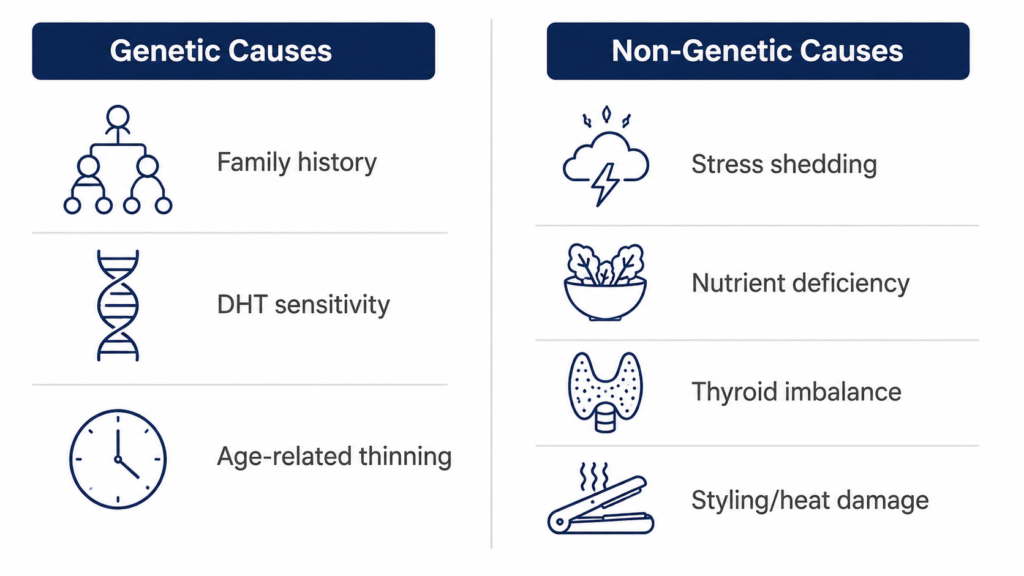
The most common cause of hair thinning in men, by a wide margin, is androgenetic alopecia — pattern hair loss driven by genes you inherited. Research summarized by the National Institutes of Health notes that androgenetic alopecia is a polygenic trait, meaning it’s shaped by multiple genes from both sides of your family, not a single “baldness gene” from your mother alone. If your father, grandfather, or uncles thinned out in a recognizable pattern — hairline, crown, or both — that’s a meaningful clue that genetics is a factor for you too.
This one is genetic.
2. DHT Sensitivity and Follicle Miniaturization
Genetics doesn’t cause hair loss directly — it determines how sensitive your hair follicles are to a hormone called dihydrotestosterone (DHT). In genetically susceptible follicles, DHT gradually shortens the hair’s growth phase and shrinks the follicle itself, a process called miniaturization, so each new strand grows back finer and shorter than the last. Over years, this produces the visible thinning most men associate with going bald, even though total follicle count barely changes at first — the hair is simply getting weaker, not disappearing outright.
This one is genetic (it’s the mechanism behind reason #1, not a separate cause).
3. Natural Age-Related Thinning
Even without a strong genetic predisposition, hair naturally thins with age. Mayo Clinic notes that hair growth naturally slows as part of aging, and hair follicles that have cycled through decades of growth phases produce progressively finer strands over time, independent of any pattern-baldness gene. This is one reason two brothers with similar genetics can still thin at noticeably different rates — age interacts with genetics rather than acting alone.
Partly genetic — age accelerates an underlying genetic tendency more than it causes thinning on its own.
4. Stress-Related Shedding (Telogen Effluvium)
A period of intense physical or emotional stress — illness, surgery, a major life event, rapid weight loss — can push a larger-than-usual share of your hair follicles into their resting phase at once. A few months later, those hairs shed together, producing a shedding spike that can look alarming but is usually temporary. This condition is called telogen effluvium, and unlike pattern hair loss, it typically resolves on its own once the triggering stressor passes.
This one is not genetic — it’s situational, though it can make an existing genetic pattern more visible sooner.
Not sure which of these applies to you? The clearest signal is pattern plus family history — if the thinning is concentrated at your hairline or crown and you can trace a similar pattern to a parent or grandparent, genetics is very likely part of the story, and that combination is worth confirming with a clinician rather than guessing on your own.
5. Nutrient Deficiencies (Iron, Protein, Vitamin D)
The American Academy of Dermatology lists nutritional deficiencies among the recognized causes of hair loss, including low iron, insufficient protein intake, and vitamin D deficiency. Hair follicles are metabolically demanding, so when the body is short on key building blocks, it deprioritizes hair growth in favor of higher-priority functions — producing diffuse thinning that’s usually reversible once the deficiency is corrected.
This one is not genetic — though some people are genetically more prone to certain deficiencies (like iron absorption issues).
6. Thyroid or Hormonal Imbalance
Both an underactive and overactive thyroid can disrupt the hair growth cycle, and Mayo Clinic identifies hormonal changes and thyroid problems as established causes of hair loss distinct from pattern baldness. This kind of thinning tends to be diffuse across the whole scalp rather than concentrated at the hairline or crown, and it’s one of the more common causes doctors rule out first because it’s straightforward to test for.
This one is not genetic, though thyroid conditions themselves can sometimes run in families for unrelated reasons.
7. Tight Hairstyles, Heat, and Chemical Damage
Constant tension from tight hairstyles, frequent heat styling, or harsh chemical treatments can cause a mechanical form of hair loss called traction alopecia, along with general breakage that looks like thinning even when follicles themselves are healthy. This is one of the few causes on this list that’s entirely within your control, and it’s the easiest to test — if thinning is concentrated exactly where tension or heat is applied most, that’s a strong clue.
This one is not genetic — it’s mechanical, and often reversible if caught early.
So Which One Applies to You?
If you can trace a recognizable pattern to a parent or grandparent, if the thinning is concentrated at the hairline or crown rather than spread evenly, and if it’s been gradual rather than sudden, genetics is the more likely driver. If the thinning followed a specific stressful event, started suddenly, or is spread diffusely across your whole scalp, a non-genetic cause is more likely — and worth ruling out with a real evaluation rather than a guess. Once you have a sense of which category you’re in, it’s worth understanding the specific early signs of a receding hairline if a genetic pattern seems likely, since catching it early gives you more to work with.
If genetics does turn out to be the main driver, it’s worth knowing what dutasteride actually does with that mechanism: this prescription DHT blocker, used off-label for hair loss, works directly on the follicle-level DHT sensitivity described in reason #2 above, and for many men with genetically driven thinning it’s associated with slower shedding and thicker-looking hair over several months of consistent use. It isn’t the right option for everyone, and off-label use should always be confirmed with a clinician who can evaluate whether your pattern is a match. See how dutasteride targets DHT-driven thinning.
Medical disclaimer: This article is for informational purposes only and is not a substitute for professional medical advice. Always consult a qualified healthcare provider before starting any hair-loss treatment or drawing conclusions about the cause of your hair thinning.
This article contains an affiliate link; we may earn a commission if you make a purchase, at no additional cost to you.
Frequently Asked Questions
Can hair thinning be genetic even if my dad has a full head of hair?
Yes. Pattern hair loss is polygenic and inherited from both sides of the family, not just your father. A grandfather, uncle, or your mother’s side can carry the relevant genes even if your father’s hairline looks fine.
How do I know if my hair thinning is genetic or from stress?
Genetic thinning is usually gradual and concentrated at the hairline or crown, while stress-related shedding (telogen effluvium) tends to start suddenly a few months after a stressful event and spreads more evenly across the scalp. A clinician can usually tell the difference with a brief exam.
What vitamin deficiency causes hair thinning?
Low iron, insufficient protein, and vitamin D deficiency are among the nutritional causes recognized by dermatology sources. This type of thinning is typically diffuse rather than patterned and often improves once the deficiency is corrected.
Can thyroid problems cause hair thinning in men?
Yes, both underactive and overactive thyroid conditions can disrupt the hair growth cycle and cause diffuse thinning across the scalp. This is unrelated to genetic pattern baldness and is usually confirmed with a simple blood test.
Is hair thinning from tight hairstyles reversible?
Often, yes, if it’s caught before the follicles are permanently damaged. Traction alopecia from tight hairstyles or constant tension can reverse once the tension stops, though long-standing cases may not fully recover.
At what age does genetic hair thinning usually start?
It varies significantly by person. Some men notice genetic pattern thinning in their late teens or twenties, while others don’t see meaningful changes until their thirties or forties — timing itself is influenced by genetics too.
Does hair thinning always mean I’m going bald?
No. Several of the causes above — stress, nutrient deficiencies, thyroid issues, styling damage — are not connected to progressive baldness and often resolve once addressed. Only genetically driven pattern thinning tends to be progressive without intervention.