
You catch it under a certain light — the bathroom fixture, a work video call, an overhead shot a friend took — and for a second the top of your head looks different than you remember. Then the moment passes and you talk yourself out of it. That in-between feeling, noticing something but not being sure whether it’s real, is exactly the stage where paying attention actually matters most. Male pattern hair loss rarely announces itself with something dramatic; it shows up in small, easy-to-dismiss details first. Here are nine early signs worth taking seriously, even if — especially if — you’re only half-sure you’re seeing them.

1. Your Scalp Is More Visible When Your Hair Is Wet
Wet hair lies flatter and closer to the scalp than dry, styled hair, which makes it a more honest preview of your actual density. If you’re noticing more scalp showing through right after a shower than you remember from a year or two ago, that’s often one of the earliest visible cues, well before it’s obvious with dry, styled hair.
2. Individual Strands Feel Thinner, Not Just Fewer
Before hair loss becomes about count, it’s usually about texture. The process of follicle miniaturization described in dermatology literature means each new strand grows back finer and softer than the one before it. Run your fingers through your hair and pay attention to whether it feels noticeably less substantial than it used to, not just whether there’s visibly less of it.
3. Thinning Is Starting at the Crown, Not Just the Front
Crown (vertex) thinning tends to develop in a roughly circular pattern at the back-top of the head, which makes it one of the hardest areas to monitor yourself — you can’t see it directly. It’s worth asking a barber or using a mirror trick (a hand mirror held up while facing a bathroom mirror) periodically, since crown thinning can progress for a while before you’d otherwise notice it. Some men experience crown and hairline changes together, while others see one develop well before the other — there’s no rule that says they progress on the same timeline.
4. You’re Finding More Hair Than Usual — Consistently
A few extra strands on your pillow or in the drain on any given day isn’t meaningful on its own — the American Academy of Dermatology notes that losing 50 to 100 hairs a day is a normal part of the hair cycle. What matters is a sustained increase over weeks, not a single bad-hair-day spike, and especially if the extra shedding seems concentrated around the crown or hairline rather than spread evenly.
5. Your Hair Takes Longer to Style the Way It Used To
When density drops even modestly, hair often needs more product, more time, or a different technique to achieve the same look it used to fall into naturally. If your usual routine suddenly requires more effort for a similar result, that’s frequently a density change registering before you’ve consciously connected the dots.
6. Hair Seems to Be Growing Back Slower Than Before
Miniaturized follicles don’t just produce finer hair — they also tend to spend less time in the active growth phase. If haircuts seem to “hold” longer than they used to, or regrowth after a cut feels slower to fill back in, that’s consistent with the same underlying process affecting texture and density.
Noticing two or three of these at once? That’s the point where getting an actual evaluation — rather than watching and waiting — tends to matter most, since the earlier this gets assessed, the more options tend to be on the table.
7. Your Father or Grandfather Went Bald Relatively Early
The American Academy of Dermatology lists heredity among the primary causes of hair loss, and a close relative who thinned out noticeably in his 20s or 30s is a real risk signal, not just a coincidence. This isn’t limited to your father’s side either — the trait is inherited from both sides of the family.
8. You’ve Started Avoiding Certain Haircuts or Angles
A subtle but telling sign: you’ve unconsciously started steering away from short haircuts, slicked-back styles, or certain camera angles that used to be no big deal. This kind of avoidance often shows up before you’d consciously say “I think I’m losing my hair” — the behavior changes first. If you’ve caught yourself declining a buzz cut you’d have gotten without thinking two years ago, that instinct is worth paying attention to rather than dismissing as pickiness.
9. Hair Loss Started Suddenly After Illness or Major Stress
This one’s slightly different from the rest — sudden, diffuse shedding a few months after an illness, surgery, or major stressor is often temporary (telogen effluvium) rather than the start of a genetic pattern. It’s still worth paying attention to, though, both because it can unmask an underlying genetic tendency sooner and because it’s worth ruling out other causes if the shedding doesn’t settle down within a few months.
What to Do With This List
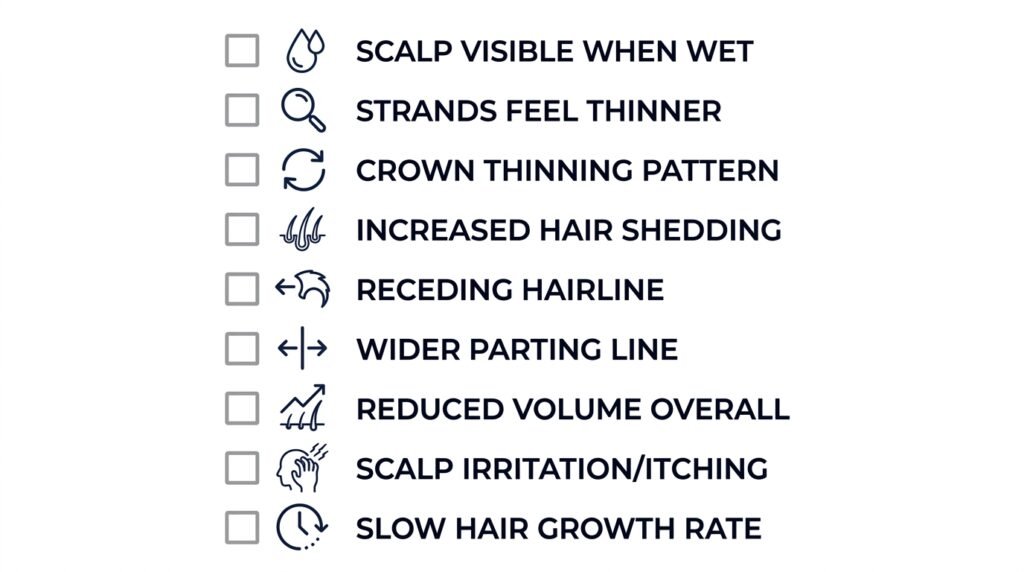
One or two of these signs alone usually isn’t a reliable signal — mild scalp visibility when wet is common, and everyone finds a few extra hairs occasionally. What’s worth acting on is a cluster: several of these signs together, trending in the same direction over months rather than days. If that sounds like where you are, it’s worth reviewing the specific early signs of a receding hairline for a closer look at the hairline piece specifically, since crown and hairline changes don’t always progress at the same pace.
It’s also worth being honest with yourself about the “shouldn’t ignore” part of this. None of these nine signs require a same-day appointment, but the men who end up with the most options tend to be the ones who took the cluster seriously within the first year rather than the fifth — not because waiting is dangerous, but because there’s simply more still there to work with early on.
And if these signs do add up to a genuine pattern, dutasteride, a prescription DHT blocker sometimes used off-label for hair loss, targets that hormonal process directly, and for many men catching it at this early stage it’s associated with slower shedding and thicker-looking hair over several months of consistent use. It isn’t appropriate for everyone, and a clinician is the right person to confirm whether it fits before you start anything. See how dutasteride targets early-stage DHT-driven thinning.
Medical disclaimer: This article is for informational purposes only and is not a substitute for professional medical advice. Always consult a qualified healthcare provider to evaluate the cause and appropriate next steps for your specific situation.
This article contains an affiliate link; we may earn a commission if you make a purchase, at no additional cost to you.
Frequently Asked Questions
What is usually the first sign of male pattern hair loss?
It varies by person, but increased scalp visibility when hair is wet and subtle temple or crown thinning are among the earliest commonly reported signs, often noticed before any change is obvious with dry, styled hair.
Can you have early hair loss and not know it?
Yes, easily. Early miniaturization changes hair texture and density gradually, and the brain tends to normalize slow change, which is why comparing photos over time or asking someone else to check the crown area is often more reliable than self-assessment alone.
Does crown thinning always mean male pattern baldness?
Crown thinning is a common presentation of male pattern hair loss, but diffuse thinning from other causes, like thyroid issues or nutrient deficiencies, can also affect the crown area. A clinician can help distinguish between the two.
How much hair loss is normal per day for men?
According to the American Academy of Dermatology, losing 50 to 100 hairs a day is a normal part of the hair growth cycle. A sustained increase well beyond that range over several weeks is what’s worth paying attention to.
Is early hair loss reversible if caught soon enough?
Catching genetically driven pattern hair loss early doesn’t reverse it on its own, but it generally means more of the follicle’s original function is still intact, which is why earlier evaluation tends to broaden the range of options available.
Can stress cause early signs that look like male pattern hair loss?
Yes. Stress-related shedding (telogen effluvium) can look similar to early pattern hair loss at first, but it’s typically diffuse rather than concentrated at the hairline or crown, and it tends to resolve within months once the stressor passes.
Should I see a doctor for early signs of hair loss, or wait to see if it progresses?
There’s no harm in getting an early evaluation, and many clinicians note that options for slowing progression are broadest earlier on. Waiting isn’t dangerous, but it does mean losing time you can’t get back if the cause turns out to be a progressive genetic pattern.