
You’ve done the research. Dutasteride keeps coming up as one of the stronger DHT-blocking options for hair loss, and you’ve booked — or you’re about to book — a few minutes with a clinician to actually talk about it. Now the practical worry sets in: fifteen or twenty minutes isn’t much time, and walking in with only “can I get this” tends to produce a rushed, generic conversation instead of a real one. People who show up with specific, informed questions to ask a doctor about dutasteride for hair loss tend to leave with an actual plan, not just a prescription decided on the fly. Here’s what’s worth knowing before that appointment happens.
Not sure yet whether what you’re noticing is actually early pattern hair loss? These early signs of a receding hairline are worth checking first.

Thing 1: Dutasteride Isn’t FDA-Approved for Hair Loss in the US
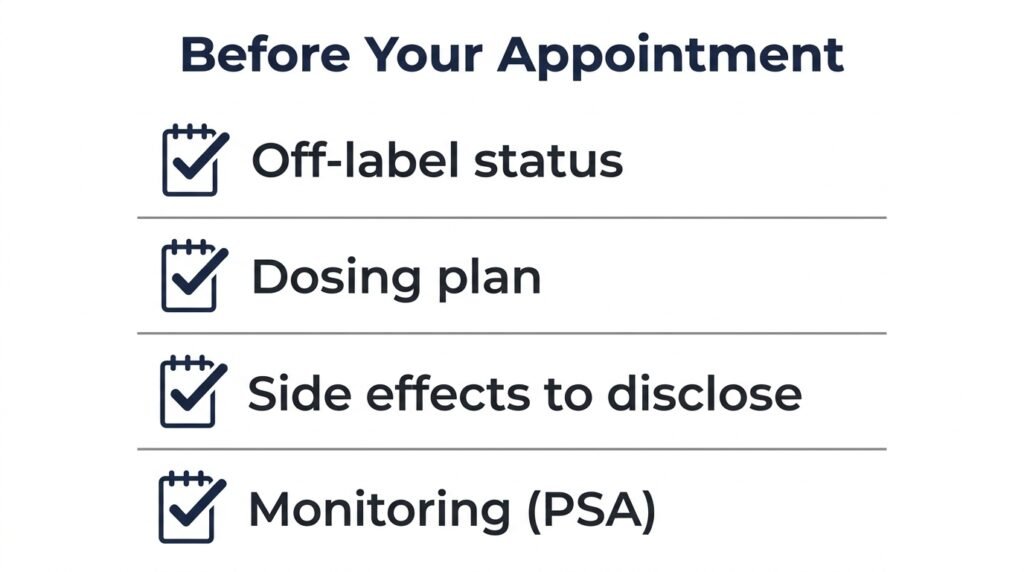
Dutasteride was originally approved to treat an enlarged prostate (benign prostatic hyperplasia). Using it for hair loss is off-label in the United States — a clinician’s judgment call, not an FDA-sanctioned indication. That’s not the same as unproven: the same drug is approved specifically for treating androgenetic alopecia in South Korea and Japan, according to a multicenter chart-review study on long-term dutasteride use published in PMC. Worth asking directly: how comfortable is this clinician prescribing it off-label, and what evidence are they weighing?
What “Off-Label” Actually Means
Off-label prescribing is common across medicine — it means a clinician is prescribing a medication outside its original FDA-approved indication, based on clinical evidence and judgment, not that the use is unregulated or experimental.
Thing 2: The Hair-Loss Dose Isn’t Always the BPH Dose
The FDA-approved BPH dose is 0.5 mg daily. Many prescribers use that same dose off-label for hair loss, though some reduce frequency — twice or three times weekly — because of how long the drug lingers in the body. Ask specifically which dosing schedule your clinician plans to use and why, rather than assuming there’s one standard protocol.
Thing 3: Its Half-Life Is Dramatically Longer Than Finasteride’s
Its half-life runs roughly four to five weeks, compared with finasteride’s six to eight hours, per StatPearls’ review of 5-alpha-reductase inhibitors. That means measurable drug can remain in your system for months after your last dose — relevant to side-effect washout, drug interactions, and any future medical decision, including trying to conceive.
Thing 4: Your Full Side-Effect Picture Is Worth Disclosing Upfront
The Mayo Clinic’s overview of oral dutasteride lists decreased libido, erectile difficulty, and breast tenderness or enlargement among the effects worth discussing candidly, particularly if you have a personal or family history of mood-related conditions. Most reported sexual side effects are described as resolving within a few months of stopping, but they’re worth naming out loud before you start, not after.
Thing 5: Certain Medications Can Change How It Behaves in Your Body
Drugs that inhibit the CYP3A4 enzyme — including some antifungals, HIV medications, and blood-pressure drugs like verapamil or diltiazem — can raise dutasteride levels in your blood. Bring your full medication list, including supplements, so this actually gets checked instead of assumed fine.
Thing 6: Blood Donation Has a Real Waiting-Period Rule
Most guidance recommends waiting around six months after your last dose before donating blood, since trace amounts could theoretically reach a pregnant recipient through a transfusion, per the FDA-approved prescribing information. If you donate regularly, this is worth flagging before you start treatment, not after a donation center turns you away.
Thing 7: Fertility Effects Are Usually Reversible, Not Guaranteed to Be Irrelevant
Some men see reduced sperm count or motility while on dutasteride, and most data suggests this reverses after stopping. If you’re actively trying to conceive, or planning to soon, that timeline is worth mapping out with a clinician rather than assuming it won’t apply to you.
Thing 8: Pregnancy Precautions Extend to Your Partner
Dutasteride can interfere with normal development in a male fetus, and it’s present in semen. If a partner is or may become pregnant, a condom is typically recommended, and women who are or may become pregnant shouldn’t handle leaking or damaged capsules. This is one of the most important things to raise before starting, not mid-prescription.
Thing 9: It Can Cut Your PSA Number Roughly in Half
Dutasteride can lower PSA levels by roughly 50% within three to six months of regular use, according to the FDA-approved prescribing information linked above, which is why a new baseline PSA test is often recommended before starting. Ask specifically how your clinician plans to adjust for that going forward.
Why PSA Monitoring Matters More As You Get Older
PSA screening is one of the main tools used to catch prostate issues early, and a falsely low reading — because it wasn’t adjusted for dutasteride — could delay a workup that matters. This is worth raising even if hair loss feels like the only reason you’re in the room.
Thing 10: The Actual Questions Worth Asking Your Doctor
A short, specific list beats a vague “what do you think.” Worth writing down: what dosing schedule and monitoring they recommend, what a realistic timeline looks like before reassessing, what would make them stop the prescription, and what the alternative options are if dutasteride isn’t a fit for your health history.
What Dutasteride Actually Does, in Plain Terms
Strip away the dosing schedule and the monitoring checklist, and here’s the core of it: dutasteride blocks Type I, II, and III 5-alpha reductase — the broadest enzyme coverage among the DHT-blocking options commonly discussed for hair loss — which is why some men bring it up specifically after a narrower option has plateaued. For men whose thinning is genetically driven, that broader, deeper DHT suppression is associated with slower shedding and thicker-looking hair over several months of consistent use, and it’s approved specifically for this use in South Korea and Japan, even though it remains off-label in the US. None of that makes it the right choice for every man in this situation — the side effects, interactions, and monitoring covered above are real considerations, and a clinician is the one who can confirm whether your health history and pattern make you a fit. See what dutasteride involves and what to ask before starting.
Bringing These Ten Things Into the Room
Walking into that appointment with these ten things already in mind won’t replace the conversation itself, but it changes the shape of it — from a five-minute prescription decision to an actual evaluation of whether this specific option fits your specific situation. That’s what to know before taking dutasteride for hair loss seriously: the off-label status, the dosing and half-life differences, the side effects and interactions worth disclosing, and the monitoring that comes after. Bring the list. Ask a professional to walk through it with you before deciding anything.
Medical disclaimer: This article is for informational purposes only and is not a substitute for professional medical advice. Dutasteride is not FDA-approved for hair loss in the United States and is discussed here as an off-label option; always consult a qualified healthcare provider before starting any hair-loss treatment.
Affiliate disclosure: this link is a sponsored referral — we may earn a commission if you make a purchase, at no additional cost to you.
Frequently Asked Questions
Is dutasteride safe for hair loss?
Dutasteride is not FDA-approved for hair loss in the United States, though it is used off-label by clinicians and is approved specifically for that use in countries like South Korea and Japan. Safety depends heavily on individual health history — side effects can include sexual side effects, mood changes, and effects on fertility and PSA testing — which is why a full clinician evaluation, not a self-diagnosis, is the appropriate way to assess whether it’s a reasonable option for you.
Can I donate blood if I’m taking dutasteride for hair loss?
Most guidance recommends waiting roughly six months after your last dose of dutasteride before donating blood. The concern is that trace amounts of the drug could theoretically be transferred to a pregnant transfusion recipient, since dutasteride can affect fetal development. If you donate blood regularly, raise this timing with both your clinician and your local blood donation center before starting treatment.
Does dutasteride affect fertility?
Some men experience reduced sperm count or motility while taking dutasteride, and available data generally suggests these changes reverse after stopping the medication. Effects vary by individual, so if you’re actively trying to conceive or planning to in the near future, it’s worth discussing a specific timeline and any precautions with a clinician before starting.
What does “off-label” mean when a doctor prescribes dutasteride for hair loss?
Off-label means a clinician is prescribing a medication outside the specific use it was originally FDA-approved for — in dutasteride’s case, an enlarged prostate, not hair loss. It does not mean the use is unregulated, experimental, or unsupported by clinical evidence; it means the prescribing decision relies more on a clinician’s individual judgment than on a formal FDA hair-loss indication.
What should I know before taking dutasteride for hair loss?
At minimum: it’s used off-label for hair loss in the US, its half-life is far longer than finasteride’s, it can lower PSA test results by roughly half, and it carries precautions around fertility, pregnancy exposure through semen, and blood donation timing. Bringing a specific list of questions to a clinician appointment, rather than a general interest in “trying it,” tends to produce a more useful conversation and a more individualized decision.
How long does dutasteride stay in your system after stopping?
Dutasteride has a half-life of roughly four to five weeks, meaning measurable amounts can remain detectable in the body for several months after the last dose. This is significantly longer than finasteride, which clears within hours, and it’s part of why decisions like blood donation timing and family-planning precautions are handled differently for dutasteride than for shorter-acting alternatives.
Does dutasteride affect PSA test results?
Yes — dutasteride can lower PSA (prostate-specific antigen) levels by roughly 50% within three to six months of regular use. Because PSA is used to help screen for prostate issues, clinicians typically recommend a new baseline PSA test before starting and factor the medication into how they interpret future results. This is worth flagging clearly, especially for older men already being screened.