
Have you ever walked into a gym and seen that vertical pulling machine in the corner — the one that looks like a rowing machine standing upright? That’s the SkiErg, and despite being overlooked by many gym-goers, it’s one of the most effective full-body cardio machines available. Whether your goal is burning fat, building cardiovascular endurance, or finding a lower-impact alternative to running, the SkiErg deserves serious attention.
This guide covers everything a beginner needs to know: what the SkiErg is, how to use it correctly, beginner-friendly workout plans, and realistic expectations based on published research — not marketing claims.

What Is a SkiErg?
The SkiErg is an indoor cardio machine originally developed by Concept2 — the same company behind the widely used Concept2 rowing machine — to help Nordic skiers train off-season. It features two cables attached to a flywheel that you pull downward in a double-pole skiing motion while standing upright.
Unlike a rowing machine (which involves a seated, horizontal pull), the SkiErg keeps you on your feet and emphasizes the upper body, core, and posterior chain. The movement pattern recruits muscles across your shoulders, lats, triceps, abdominals, glutes, and legs in a coordinated, compound motion.
A 2025 study published via PubMed examined the effects of ski ergometer training on respiratory functions and isokinetic muscle strength, finding measurable improvements in both areas among trained athletes. While most research has been conducted on competitive skiers, the machine’s mechanics make it accessible and beneficial for general fitness beginners as well.
Why the SkiErg Is Effective for Cardio and Fat Burning
The SkiErg’s fat-burning efficiency comes down to one core principle: more muscles working simultaneously means greater energy demand. According to the National Heart, Lung, and Blood Institute (NHLBI), aerobic exercise that engages large muscle groups is most effective for cardiovascular health and calorie expenditure — and the SkiErg fits that description well.
The National Institute on Aging (NIA) highlights that combining endurance-type exercise with activities that engage multiple muscle groups provides compounded health benefits — including improved cardiovascular fitness, better muscular endurance, and support for healthy body weight.
The SkiErg also produces Excess Post-Exercise Oxygen Consumption (EPOC) — the “afterburn effect” where your metabolism remains elevated after your workout ends. High-intensity interval training (HIIT) and full-body exercises like the SkiErg tend to produce a stronger EPOC response than steady-state, lower-body-only cardio like jogging.
SkiErg vs Running: How Do They Compare?
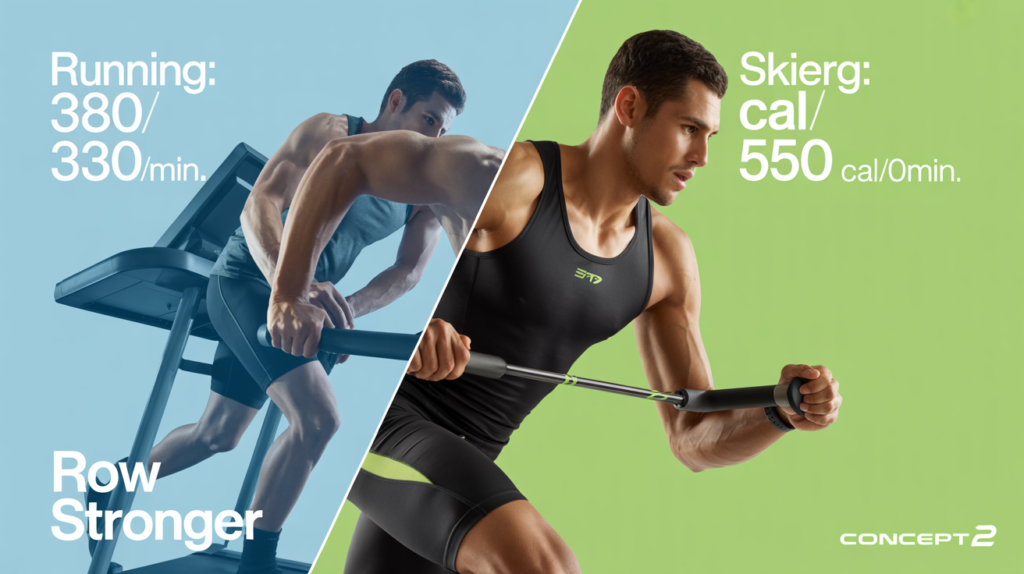
Both the SkiErg and running are effective cardio options. The key difference lies in muscle recruitment and joint impact. Running is primarily lower-body dominant, while the SkiErg engages both the upper and lower body. For beginners with knee or ankle sensitivity, or those seeking upper-body cardiovascular training, the SkiErg offers a meaningful advantage.
Approximate 30-Minute Calorie Burn (estimates vary by body weight and effort):
| Activity | ~140 lb Person | ~180 lb Person | ~220 lb Person |
|---|---|---|---|
| Running (6 mph) | ~240 cal | ~310 cal | ~380 cal |
| SkiErg (moderate) | ~260 cal | ~330 cal | ~400 cal |
| SkiErg (high intensity) | ~320 cal | ~410 cal | ~500 cal |
Note: Calorie estimates are approximate and depend heavily on individual fitness level, intensity, and effort. Use them as a general guideline, not a precise measurement.
From a joint-stress perspective, the SkiErg’s standing, non-impact motion places significantly less load on the knees and ankles compared to running. This makes it a practical option for people who want intense cardio without the repetitive impact.
What Muscles Does the SkiErg Work?
The SkiErg engages a wide range of muscle groups in a single movement pattern:
- Latissimus dorsi (lats): Primary pulling muscles during the downward cable pull
- Triceps and shoulders: Drive the initial pull-down phase
- Core (abdominals and obliques): Stabilize the torso throughout the movement
- Glutes and hamstrings: Activated during the hip-hinge phase
- Lower back (erector spinae): Maintains posture and spine stability
- Calves and quads: Provide ground-force stability
How to Use the SkiErg: Proper Form for Beginners
- Starting position: Stand facing the machine with feet roughly hip-width apart. Reach up and grip both handles.
- The pull: Drive your elbows down and back, engaging your lats. Your arms and torso should move together, not just your arms alone.
- Core engagement: Brace your core throughout the entire movement to protect your lower back and generate more power.
- Hip hinge: Allow a slight bend at the hips (not the knees) as you pull down — this activates the glutes and posterior chain.
- The return: Let the handles rise back up under control, following the cable’s natural path. Don’t let them snap upward.
Form checklist:
- Shoulders stay relaxed and down, not hunched ✓
- Core stays braced throughout ✓
- Slight forward lean from hips, not the waist ✓
- Smooth, rhythmic movement — not jerky ✓
- Handles return to full height between strokes ✓
Concept2’s official Beginner’s SkiErg Training Program recommends prioritizing form over speed in your first 2–3 sessions before adding any intensity.
5 Beginner-Friendly SkiErg Workouts
1. The 10-Minute Form Builder (Week 1 Foundation)
- 2 minutes easy pace — focus entirely on technique
- 30 seconds moderate effort / 1 minute easy recovery — repeat 5 times
- 1 minute cool-down
2. The 15-Minute Interval Starter
| Time | Intensity | Focus |
|---|---|---|
| 0–3 min | Easy warm-up | Nail your form |
| 3–4 min | Hard (85% effort) | Push your pace |
| 4–5 min | Easy recovery | Catch your breath |
| 5–6 min | Hard | Maintain form under fatigue |
| 6–7 min | Easy recovery | Control breathing |
| 7–8 min | Hard | Last push |
| 8–15 min | Easy cool-down | Heart rate recovery |
3. The 20-Minute Steady-State Endurance Session
The NHLBI recommends at least 150 minutes of moderate-intensity aerobic activity per week for adults. This 20-minute session contributes meaningfully toward that target.
- 3-minute warm-up at easy pace
- 14 minutes at a comfortable, conversational pace
- 3-minute cool-down
4. The 12-Minute HIIT Protocol (Weeks 3–4 Only)
- 2-minute warm-up
- 20 seconds all-out effort / 40 seconds easy recovery — repeat 8 rounds
- 2-minute cool-down
5. The 25-Minute Mixed-Intensity Session (Advanced Beginner)
- 5-minute progressive warm-up
- 3 minutes moderate → 1 minute hard → 2 minutes easy (repeat 3 times)
- 2-minute cool-down
How Many Calories Does the SkiErg Burn?
| Fitness Level | Light Effort (per hour) | Moderate Effort (per hour) | High Effort (per hour) |
|---|---|---|---|
| Beginner | 380–480 cal | 520–620 cal | 650–750 cal |
| Intermediate | 480–580 cal | 620–720 cal | 750–860 cal |
| Advanced | 560–660 cal | 710–820 cal | 850–960 cal |
These are estimated ranges based on general aerobic exercise data. Individual results vary based on body weight, effort, and fitness level.
7 Common SkiErg Mistakes Beginners Should Avoid
- Pulling with arms only — power should come from your back and core
- Going too fast with poor form — master technique at a slow pace first
- Hunching the upper back — stand tall, chest lifted
- Squatting instead of hip-hinging — subtle hip bend, not a deep squat
- Gripping the handles too tightly — relaxed grip allows full range of motion
- Uneven or rushed timing — aim for consistent, rhythmic strokes
- Not letting handles return fully — full return maximizes range of motion and muscle activation
4-Week SkiErg Beginner Plan
| Week | Days/Week | Session Length | Focus |
|---|---|---|---|
| Week 1 | 3 | 10–15 min | Form, basic endurance |
| Week 2 | 3–4 | 12–18 min | Add short intervals |
| Week 3 | 4 | 15–22 min | Longer intervals, more volume |
| Week 4 | 4–5 | 18–25 min | Peak beginner intensity |
References
- PubMed — Effects of Ski Ergometer-Based Training on Respiratory Functions and Isokinetic Muscle Strength (2025)
- National Heart, Lung, and Blood Institute (NHLBI) — Types of Physical Activity
- National Institute on Aging (NIA) — Three Types of Exercise That Improve Health
- Concept2 — Beginner’s SkiErg Training Program
⚠️ Medical Disclaimer: This article is for informational and educational purposes only. It is not a substitute for professional medical advice, diagnosis, or treatment. Calorie estimates and workout suggestions are general guidelines that may not apply to every individual. Before beginning any new exercise program — especially if you have a pre-existing medical condition, cardiovascular concern, or injury — consult a licensed physician or qualified healthcare provider. This site does not endorse any specific fitness equipment or brand. If you think you may be experiencing a medical emergency, call 911 or your local emergency services immediately.
Frequently Asked Questions: SkiErg Workout for Beginners
What is a SkiErg and how does it work?
A SkiErg is a vertical pull-cable cardio machine that simulates the double-pole motion of cross-country skiing. You stand and pull two cables downward using a flywheel resistance system, engaging your upper body, core, and lower body simultaneously. It was originally developed by Concept2 for off-snow Nordic ski training but is now widely used for general cardiovascular fitness.
Is the SkiErg good for complete beginners?
Yes. The SkiErg is adjustable in resistance and pace, making it suitable for beginners. Start with short sessions (10–15 minutes) at a comfortable pace and focus on learning proper form before increasing intensity or duration. Concept2 offers a beginner-specific training program to help new users get started safely.
How many calories does a SkiErg burn in 30 minutes?
A 30-minute SkiErg session typically burns between 200–400 calories, depending on body weight, fitness level, and effort intensity. Higher-intensity HIIT sessions will burn more than moderate steady-state efforts. These are estimates — individual results vary significantly.
What muscles does the SkiErg work?
The SkiErg primarily targets the latissimus dorsi (lats), triceps, shoulders, and core. Secondary muscles include the glutes, hamstrings, lower back, and leg stabilizers. This broad recruitment makes it a genuine full-body exercise.
Is the SkiErg low impact and safe for bad knees?
The SkiErg is a non-impact exercise that places minimal stress on the knees and ankles. It is often recommended as a cardio alternative for people with lower limb injuries or joint sensitivity. If you have a diagnosed knee condition, consult your doctor before starting any new exercise program.
How often should a beginner use the SkiErg?
Beginners should aim for 2–3 sessions per week with rest days between sessions. This allows cardiovascular adaptation while giving muscles time to recover. As fitness improves over 3–4 weeks, you can increase to 4–5 sessions per week.
How long before I see results from SkiErg workouts?
Most people notice improved cardiovascular endurance (less breathlessness during workouts) within 2–3 weeks of consistent training. Visible body composition changes depend on diet, overall activity level, and starting fitness — and typically become noticeable after 4–8 weeks of regular, consistent training.
Can I use the SkiErg if I have a shoulder injury?
The SkiErg places significant load on the shoulders and upper back. If you have a shoulder injury, rotator cuff issue, or any upper body condition, consult a licensed physical therapist or physician before using the SkiErg. They can assess whether it’s appropriate and may recommend form modifications or alternative exercises.
Is SkiErg better than running for fat loss?
Neither is categorically better — both are effective for fat loss when combined with a balanced diet. The SkiErg engages more muscle groups simultaneously, which can increase calorie burn per session versus moderate-paced running. The best exercise is the one you’ll do consistently. Many people benefit from alternating both for variety and balanced fitness development.