
You’ve narrowed it down to two names — finasteride and dutasteride — and now you’re trying to work out what actually separates them beyond “they both block DHT.” Maybe a friend takes one, your search results keep surfacing the other, and you don’t want to walk into an appointment repeating whatever the loudest forum thread said. Comparing finasteride vs dutasteride for hair loss comes down to five well-documented differences: mechanism, potency, approval status, side effects, and dosing — so you know exactly what to ask when you sit down with a clinician.
If you’re still confirming this is actually male pattern hair loss and not something else going on, these early signs of a receding hairline are worth reviewing first — the differences below matter most once DHT-driven hair loss is confirmed as what you’re actually dealing with.

Difference 1: They Target Different Versions of the Same Enzyme
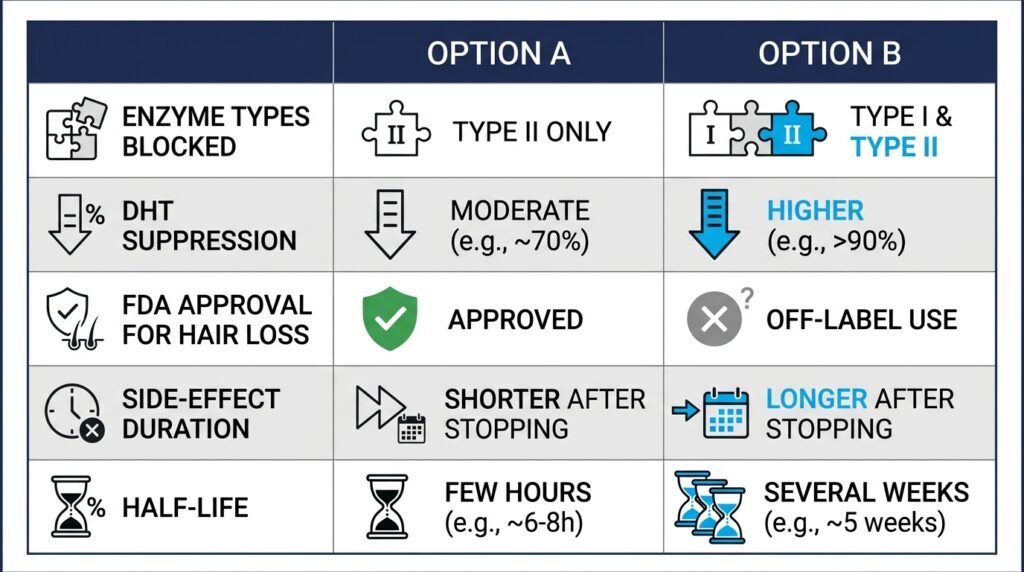
Finasteride vs dutasteride mechanism of action comes down to which forms of an enzyme called 5-alpha reductase each drug blocks. Both medications inhibit 5-alpha reductase, the enzyme that converts testosterone into DHT (dihydrotestosterone), the hormone responsible for shrinking genetically susceptible hair follicles. Where they diverge is coverage: finasteride is a competitive inhibitor of primarily the Type II 5-alpha reductase isoenzyme, according to StatPearls’ clinical overview of finasteride, while dutasteride blocks Types I, II, and III. Broader enzyme coverage generally means more thorough DHT suppression throughout the body, not just at the scalp.
Type II vs Types I, II, and III — Why This Distinction Matters
Type II 5-alpha reductase is concentrated in hair follicles, the prostate, and other reproductive tissue — part of why finasteride was originally developed for both conditions. Type I is more active in skin and liver tissue. Dutasteride’s coverage of all three types means it interrupts DHT production in tissues finasteride’s narrower mechanism doesn’t reach as completely. Whether that translates into a meaningfully different outcome for your specific hair loss is exactly the nuance a clinician can walk through with your history in view — mechanism alone doesn’t decide it.
Difference 2: Dutasteride Suppresses More DHT Than Finasteride
Dutasteride’s DHT suppression percentage vs finasteride is one of the most cited numbers in this comparison. Finasteride reduces serum DHT by roughly 70%, while dutasteride reduces it by approximately 90–98%, according to StatPearls’ clinical review of dutasteride. That gap in DHT suppression is the pharmacological basis for research suggesting dutasteride may produce somewhat greater hair-count improvements for some patients.
What a Bigger DHT Reduction Doesn’t Automatically Mean
A larger percentage on paper isn’t a guaranteed better outcome for you personally. Individual response depends on factors a lab value can’t fully capture — existing follicle miniaturization, how long hair loss has progressed, individual hormone sensitivity. A stronger DHT-suppression profile is one input into a treatment decision, not the deciding factor, and it doesn’t replace an individualized evaluation.
Difference 3: Only Finasteride Is FDA-Approved for Hair Loss
Is dutasteride FDA-approved for hair loss? Not in the United States. Finasteride (1 mg) has carried FDA approval specifically for male pattern hair loss since December 1997, making it the established first-line oral option with two-plus decades of hair-loss-specific safety data behind it. Dutasteride (0.5 mg) is FDA-approved only for benign prostatic hyperplasia, per the FDA-approved prescribing information for dutasteride — its use for hair loss in the U.S. is off-label, though it carries formal approval for that use in several other countries.
What “Off-Label” Actually Means Here
Off-label doesn’t mean unstudied or unsafe — it means a medication is prescribed for a condition outside what a regulatory body has formally approved it for in a given country. Multiple randomized clinical trials support dutasteride’s use for hair loss, but the status is still a meaningful factor worth raising directly with a clinician rather than assuming it doesn’t matter.
Difference 4: Side Effects Overlap, But How Long They Last Doesn’t
Finasteride vs dutasteride side effect differences show up less in which side effects occur and more in how long they last if they do. Both medications carry a similar list of potential side effects — decreased libido, erectile difficulty, mood changes — occurring in a small percentage of users for either drug. A population-based study examining long-term outcomes associated with 5-alpha reductase inhibitors, published in a peer-reviewed analysis on PMC, is part of the broader long-term safety picture for this drug class — more extensive for finasteride simply because it’s had longer to accumulate data.
Why Dutasteride’s Longer Half-Life Changes the Side-Effect Conversation
If a side effect appears, how quickly it resolves after stopping differs meaningfully between the two drugs — covered fully in the dosing section below. In practice, that means side-effect management looks different: discontinuing finasteride produces a faster change in drug levels than doing the same with dutasteride. That’s worth weighing directly with a clinician, particularly if reversing a side effect quickly matters to you.
Difference 5: Half-Life and Dosing Schedule Aren’t Even Close
Finasteride vs dutasteride half-life and dosing schedule is where these two medications look the least alike. Finasteride has an elimination half-life of roughly 5 to 6 hours, while dutasteride’s half-life runs approximately 4 to 5 weeks, per StatPearls’ clinical review of dutasteride (cited above). Both are typically taken as a once-daily oral dose, but what happens after you stop taking them is where the real practical difference shows up.
How Long Dutasteride Stays in Your System vs Finasteride
Finasteride clears your system within a day or two of stopping. Dutasteride can remain detectable in the bloodstream for months after the last dose, a direct result of its much longer half-life — worth knowing if you’re weighing a planned procedure, a family-planning decision, or simply reassessing treatment down the line. That same longer half-life is part of why dutasteride sustains deeper, more consistent DHT suppression day to day, which some research has linked to greater average hair-count improvement for certain men — a tradeoff some men bring up specifically after plateauing on finasteride.
See what broader DHT suppression with dutasteride looks like in practice, including what to ask a clinician before switching.
Which One Is Right for You? That’s a Clinician Question, Not a Guessing Game
None of these five differences point to one medication being universally “better” — they point to different tradeoffs. Broader enzyme coverage and higher DHT suppression on one side; a longer FDA-approved track record specific to hair loss on the other. A half-life that clears quickly versus one that requires more commitment to reverse. The right answer depends on your hair-loss pattern, your health history, and how each tradeoff weighs for you personally — exactly the evaluation a clinician is positioned to make. Walking into that conversation already understanding these five differences means you’ll spend the appointment making a decision, not catching up on the basics..
Medical disclaimer: This article is for informational purposes only and is not a substitute for professional medical advice. Finasteride and dutasteride are prescription medications; dutasteride is not FDA-approved for hair loss in the United States. Always consult a qualified healthcare provider before starting, switching, or stopping any hair-loss treatment.
Affiliate disclosure: this link is a sponsored referral — we may earn a commission if you make a purchase, at no additional cost to you.
Frequently Asked Questions
Is dutasteride better than finasteride for hair loss?
Neither is universally “better” — they’re different tradeoffs. Dutasteride suppresses more DHT and blocks a broader range of the enzyme responsible for producing it, which some research links to greater hair-count improvement. Finasteride carries FDA approval specifically for hair loss and decades more hair-loss-specific safety data, plus a much shorter half-life if you ever need to stop. Which tradeoff fits your situation is a decision best made with a clinician who knows your full health history, not a blanket answer.
Can you switch from finasteride to dutasteride?
Switching is something clinicians do discuss with patients, typically when finasteride hasn’t produced the expected results after a reasonable trial period, or when someone wants to explore a medication with broader DHT suppression. Because dutasteride’s much longer half-life means it stays active in the body for weeks after finasteride would have cleared, a clinician needs to evaluate the switch directly rather than having it self-managed.
Can you take finasteride and dutasteride together?
This isn’t something to decide on your own. Both medications work on the same enzyme pathway, and combining two 5-alpha reductase inhibitors isn’t standard practice for hair loss — there’s no established evidence that stacking them improves results beyond what dutasteride alone achieves, since dutasteride already covers the enzyme type finasteride targets. Any question about combining medications belongs in a direct conversation with a prescribing clinician.
Does dutasteride grow more hair than finasteride?
Some clinical research has found dutasteride associated with greater improvements in hair count and density compared with finasteride at standard doses, which tracks with its broader enzyme coverage and higher DHT suppression. That’s a population-level finding, though — individual results vary substantially, and a bigger average effect in a study doesn’t guarantee a bigger personal result. No hair-loss treatment can promise regrowth for every user.
What is the actual difference between finasteride and dutasteride for hair loss?
The differences between finasteride and dutasteride for hair loss come down to five things: which forms of the DHT-producing enzyme each one blocks, how much DHT each one suppresses, whether it’s FDA-approved specifically for hair loss, how their side-effect durations differ, and how long each stays in your system after your last dose. Finasteride is narrower-acting, FDA-approved for hair loss, and clears quickly. Dutasteride is broader-acting, used off-label for hair loss in the U.S., and clears slowly.
Is dutasteride safer than finasteride?
“Safer” isn’t the right framing — both have broadly similar side-effect profiles in clinical trials, and safety questions come down to your individual health history more than a head-to-head ranking. What does differ is how long each stays active in your body: finasteride clears in a day or two, while dutasteride can remain detectable for months. That’s a meaningful practical consideration, but it’s a tradeoff to discuss with a clinician, not a verdict on which drug is inherently safer.
How long does it take to see results from dutasteride vs finasteride?
Both medications generally follow a similar timeline: little to no visible change in the first couple of months, early signals like reduced shedding around months two to four, and more noticeable results between months six and twelve. Dutasteride’s faster and deeper DHT suppression doesn’t necessarily translate into a faster visible timeline, because hair follicles still operate on their own multi-month growth cycle regardless of which medication is used.