
You started treatment. You’ve been consistent about it. And somewhere around week eight or ten — maybe twelve — you look in the mirror and see the same hairline you started with. Same part. Some days the same hair in the drain. At that point, most people start wondering if they’re simply in the group this doesn’t work for. Here’s what most of them never find out: they were actually ahead of where results start to show. How long hair-loss treatments take to work is almost entirely determined by biology, not by the treatment’s strength — and the biology runs on its own schedule. These seven things explain what’s actually happening and when to genuinely expect a change.

Still trying to confirm whether what you’re seeing is actually hair loss? These early signs of a receding hairline are a useful starting point before this article.
Thing 1: The Honest Answer — Most Treatments Need Months, Not Weeks
Effective hair-loss treatments typically produce the first visible results somewhere between three and six months in, with full results often appearing closer to nine to twelve months, according to the American Academy of Dermatology’s guidance on treating male pattern hair loss. That timeline is not a product flaw — it is the pace of follicle biology. These treatments work by changing the conditions that hair follicles grow in, but the hairs already on your scalp when you start have already committed to their current growth cycle. The treatment is doing something, but that cycle has to complete first before anything changes in the mirror.
Thing 2: Your Hair Growth Cycle Is Why the Timeline Runs This Long
Each hair on your scalp moves through three phases: anagen (active growth, lasting roughly two to six years), catagen (a brief transition period), and telogen (a resting phase of around three to four months, ending in shedding). At any given moment, approximately 85–90% of scalp hairs are in the anagen phase, according to research on the integrative biology of the hair growth cycle published in PMC. When you start a hair-loss treatment, it cannot redirect hairs that are already mid-cycle. It has to wait for the next cycle to begin influencing those follicles — which is exactly why the first month of treatment looking identical to the month before is the expected experience, not a warning sign.
Thing 3: Early Shedding After Starting Treatment Is Usually Not a Bad Sign
Many people notice more hair in the drain during the first few weeks after starting a hair-loss treatment. That’s alarming but typically a normal part of the process. What is happening: the treatment is pushing older, weakened hairs that were already in the telogen phase into the shedding stage, clearing the way for the next growth cycle to begin. This temporary increase in shedding is an expected phase — not an exception, and not evidence of harm.
The First Signals That Something Is Actually Changing
Early positive signals tend to be subtle. Most people do not notice dramatic regrowth first — they notice less loss. Fewer hairs in the shower, less accumulation on a pillow, a part line that has stopped widening. These reductions in daily shedding typically appear between months two and four and are more reliable early indicators than any visible new hair. If you are seeing this, things are moving in the right direction even if the mirror doesn’t show it yet.
Thing 4: What Most People Actually Experience, Month by Month
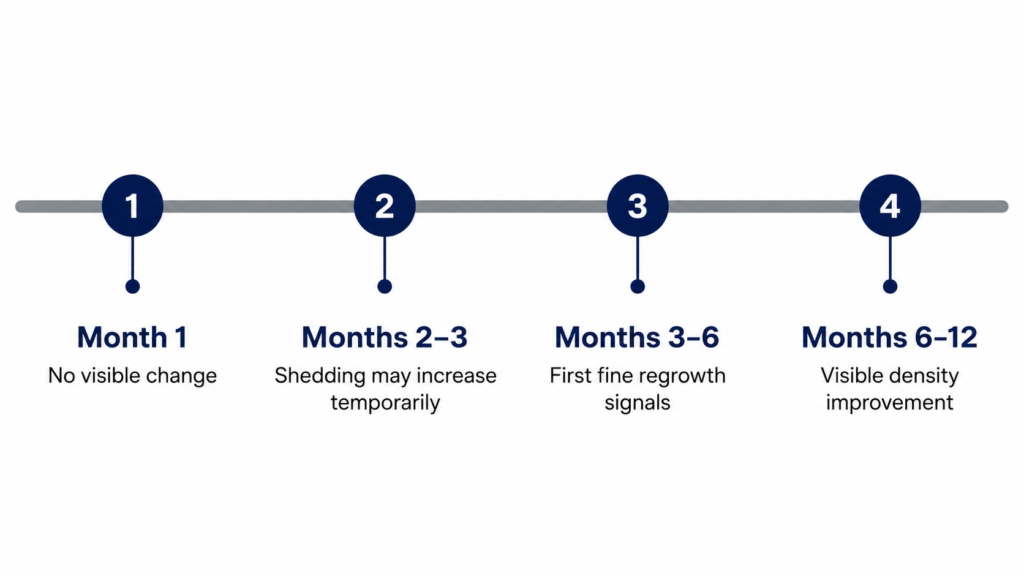
Here is a general picture drawn from clinical research and patient outcomes. Individual results vary — this is a pattern, not a guarantee:
- Month 1: No visible change for most people. The treatment is acting on follicle biology, but existing hairs are still running their current cycle.
- Months 2–3: Possible temporary increase in shedding. Some people notice a reduction in daily shed count toward the end of this window — a quiet but meaningful signal.
- Months 3–6: The first real signal. Fine new hairs may appear at the hairline or part. Daily shedding typically continues to decrease.
- Months 6–12: Visible density gains for most responders. Hair tends to look thicker and fuller compared to where it was at the start.
Three Months In and Nothing to Show? That’s Still in Range
Three months is not the finish line — it is roughly when the earliest responders begin noticing anything at all. If you are at month three and the mirror looks the same, that is within the expected window. A randomized clinical pilot study in JAAD International found no statistically significant improvement in hair density before the 24-week mark in participants on DHT-blocking treatments, even with consistent daily use from day one — see the full study results. Month three is too early to call a treatment ineffective.
When Regrowth Typically Becomes Visible
Most people first notice visible regrowth between months four and six. Full results take longer — twelve months is the standard outcome point in most clinical studies of medical hair-loss treatments. Measuring at month three means looking at an incomplete picture.
How to Track Progress Without Checking the Mirror Every Day
Consistent photographs taken under the same lighting, from the same angle, monthly — not daily — are the most useful tool. The part line and temple area tend to show early changes before you would notice anything by feel. Counting shed hairs over a consistent period (same brush, same drain trap, same duration) gives a rough trend. The goal of tracking is spotting a trend over months, not a day-to-day comparison.
Thing 5: DHT-Blocking Treatments Work Faster Biochemically — But the Scalp Still Needs Time
DHT (dihydrotestosterone) is the signal that tells susceptible follicles to shrink and stop producing normal hair. A DHT-blocking treatment can begin suppressing that signal significantly within weeks of consistent use — meaning biochemically, something real is happening long before your mirror reflects it. The catch is that removing the signal doesn’t reverse affected follicles overnight. It creates the conditions for each follicle to begin recovering on its own biological schedule. Two people using the same treatment with identical consistency can see meaningfully different timelines for this reason — their follicles are responding, just at their own pace. The answer to “is it working?” is often yes — just not yet visibly.
The Temporary Shedding Increase Some People Notice Early On
Some people on DHT-blocking treatments experience a burst of increased shedding early in the process — sometimes called the “dread shed.” The mechanism is the same as the general early shedding phase: follicles that were being miniaturized shift into a new cycle and push out the old hair first. This treatment-related telogen effluvium typically resolves within eight to twelve weeks. It is not a sign the treatment is failing. If shedding is severe, prolonged beyond three months, or accompanied by scalp discomfort or other symptoms, that is worth raising with a clinician.
Thing 6: Consistency Is the Treatment — What Missed Doses Actually Do
Hair-loss treatments that work by maintaining suppressed DHT levels depend on consistent daily use to hold those levels down. Skipping doses is not a neutral act: DHT can rebound relatively quickly when medication is missed, which disrupts the recovery environment that follicles are operating in. Consistency is not a suggestion layered on top of the treatment — it is built into how these treatments produce results. A reminder routine matters more than willpower.
What Happens When You Stop Treatment Entirely
Most gains made with medical hair-loss treatment are maintained only while treatment continues. When someone stops, DHT levels typically recover within weeks, and hair loss resumes at roughly the rate it would have continued had treatment never started. In most cases, the density gained during treatment returns toward the pre-treatment baseline within six to twelve months of stopping. The Mayo Clinic’s overview of male pattern baldness confirms this pattern — which is why most clinicians discuss hair-loss treatment in terms of ongoing management rather than a fixed course with an end date.
Thing 7: If Month 6 Passes Without Change, That’s a Conversation Worth Having
Six months is a reasonable check-in point — not a failure signal, but a meaningful marker. Some people genuinely do not respond to a given treatment approach, and some hair loss has contributing factors — nutritional deficiencies, thyroid function, other hormonal variables — that interact with pattern hair loss and can blunt what would otherwise be an effective approach. A clinician can evaluate whether your current approach fits your situation, whether adjustments make sense, or whether something else needs to be ruled out first.
Not Responding Doesn’t Mean the Category Is Wrong
Non-response to one treatment does not mean all DHT-blocking options are ruled out — they differ in how aggressively they act on the DHT pathway, and what fits one person’s situation won’t fit another’s. Dutasteride, for instance, blocks a broader range of the DHT-producing enzyme than some other DHT blockers, and that broader coverage has been linked in research to greater average hair-count improvement for some men — one reason it comes up specifically once a first approach has plateaued. If you’ve reached the six-month mark without meaningful change, that’s worth bringing directly into a clinician conversation.
See what broader DHT-enzyme coverage with dutasteride involves and what to ask before switching.
Putting the Timeline in Perspective
The common thread across all seven points is that the hair loss treatment results timeline is driven by biology, not by the treatment’s ambition. Follicles operate on multi-month cycles, and any treatment that influences those cycles has to operate on the same schedule. Consistent treatment, realistic expectations about when results appear, and a professional check-in if six months pass without any change — that is the framework most people find actually works. Quitting at month two or three means abandoning a process that, for most people, had not even reached the point where results could show yet.
Medical disclaimer: This article is for informational purposes only and is not a substitute for professional medical advice. Always consult a qualified healthcare provider before starting any hair-loss treatment.
Affiliate disclosure: this link is a sponsored referral — we may earn a commission if you make a purchase, at no additional cost to you.
Frequently Asked Questions
How long does it typically take for hair loss treatment to start working?
Most people see no visible changes in the first one to two months. Subtle early signals — reduced daily shedding, a part line that stops widening — typically appear between months two and four. Visible regrowth for most people begins around months four to six, and the full effect of most treatments develops over nine to twelve months. Expecting results in the first few weeks sets an unrealistic benchmark that tends to lead to stopping too early.
Is shedding more hair normal after starting treatment?
Yes, increased shedding in the first few weeks is common and is usually a sign that the treatment is engaging the hair growth cycle rather than damaging it. Older, weakened hairs in the telogen phase get pushed out as the follicles prepare for a new growth cycle. This shedding phase typically peaks around weeks four to eight and resolves on its own. Severe shedding, shedding that continues beyond three months, or shedding accompanied by scalp irritation or other symptoms is worth raising with a clinician.
What are the first signs a hair loss treatment is working?
The earliest signs are reductions in loss rather than visible new growth. Fewer hairs in the shower, less on the pillow, and a part line that stabilizes tend to appear before any new hair is visible. Fine, soft new hairs at the temples or part line are typically the first visible growth signal, usually appearing between months three and six. If shedding has slowed and the part line has stabilized, those are positive indicators even if you cannot see new growth yet.
What happens if I stop my hair loss treatment?
Stopping treatment allows the underlying biological driver — typically elevated DHT activity at susceptible follicles — to resume. Most people who discontinue a medical hair-loss treatment see their hair return toward the pre-treatment baseline within six to twelve months. The density gained during treatment is generally maintained only while the treatment continues. For this reason, most clinicians frame medical hair-loss treatment as ongoing management rather than a finite course with a clear stopping point.
Why am I still losing hair three months into treatment?
Continued shedding at three months is normal and expected for most treatments. Hair follicles operate on multi-month cycles, and addressing the underlying cause does not immediately stop hairs that are already in the telogen phase from completing their cycle and shedding. Clinical data generally does not show significant hair density improvement before the six-month mark. If shedding seems to be accelerating rather than stabilizing by months four or five, that is worth discussing with a clinician — but three months alone is not enough time to assess a treatment’s effectiveness.
Does missing doses of hair loss medication affect results?
Yes, missed doses have a real effect. For medications that work by maintaining suppressed DHT levels, inconsistent use allows DHT to rebound, which disrupts the recovery environment for hair follicles. Occasional missed doses are less damaging than chronic inconsistency, but daily adherence is built into how these treatments produce results — it is not a bonus feature. A reliable daily reminder tends to work better than trying to manage it by memory alone.
When should I talk to a doctor if my hair loss treatment isn’t working?
Six months is a reasonable check-in point. Before that, the absence of visible change is generally still within the normal range for most treatments. At six months with no sign of stabilization or improvement, a clinician can evaluate whether the current approach is right for your type of hair loss, whether contributing factors need to be addressed, or whether an adjusted approach would better fit your situation. Not responding to one approach does not mean all treatment categories are off the table — that is the kind of assessment best made with a professional who can review your full picture.